After his meeting with the Dean, Brofelby was summoned by a chain of administrators: a vice-provost, a provost, a vice-president, a president. They all asked the same questions, and he gave them all the same reply: no more grades.
But it's part of the job, they pleaded.
No.
They were hesitant to accuse him, openly, of insubordination. He had taught at the college for twenty-five years. He was well-liked. There was also the union to consider, but it was hard to imagine how the union could support him on this. Grades were part of the contract. Yet he refused.
Finally Brofelby was called before the Board of Trustees.
When he arrived, he was reminded of when he interviewed for this job, two-and-a-half decades ago. He was single at the time--fresh out of graduate school, with ambitious plans of forcing Plato and John Dewey onto unsuspecting first-year students. Oh, all the terrible ideas he tried to put into practice! PowerPoint presentations on comma splices!! Automatic C+ for anyone who mixes up "it's" and "its"!!! And now here he was--older, wiser--with his grandest terrible idea yet. He loved it; he feared it; he clung to it like it was his destiny. No more grades.
Brofelby sat at one head of the conference table in the board room. The Chair of the Board sat at the other end. The rest of the board members filled out starboard and port. The proceedings, at last, began.
"I think we're all here," said the Chair. "Let's get started.
"Thank you, professor, for joining us today. We've heard from the President, Vice-President, Provost, and Vice-Provost--as well as your Dean--that you have taken a rather peculiar stance lately on the issue of grades. We've heard that you refused to give any grades at the end of the Fall term. Is that correct?"
"Yes, that's right."
"And why exactly is that?"
"It's better this way."
The board members shifted their gazes back and forth, as if watching Federer and Nadal.
"Explain, please."
"I would prefer not to."
This was a little joke that Brofelby couldn't resist, but no one seemed to get it. Instead, they were simply puzzled, annoyed, and more than a little shocked.
"And what about in the Spring. Will you be grading this upcoming semester?"
"No. No more grades."
"Professor, pardon my frankness, but how can you expect us to continue to employ you if you will not grade your students' work?"
"I'd still like to teach. I enjoy teaching."
"Isn't grading part of teaching?"
"No. Not at all."
"Please, explain."
"I would prefer not to."
It wasn't a joke anymore. What would be the point of explaining? They wouldn't understand. Maybe years ago they could have. But not anymore. Or even if they did, they'd be too afraid to admit that they did.
"Well if you're not willing to discuss these matters with us..."
"It's not that I'm not willing...."
Brofelby and the Chair both seemed stuck in an extended pause.
"But you'd prefer not to," the Chair finally said.
"Exactly," said Brofelby.
"Well I guess we'll have to respect that."
Brofelby thanked the Board for their time and saw himself out. The Chair and the rest of the Board remained to discuss what to do with him. Brofelby noticed that the dining staff had already set up the Board's lunch buffet, and so he decided to help himself before leaving. Roasted vegetable wrap, potato salad, and one of those delicious little chocolate mousse cups. He decided he better enjoy it--in case it was his last supper.
A week before the Spring semester was to begin, Brofelby received a call from the Dean.
"Is this it, then?" Brofelby asked, fatalistically.
"No one's talking about firing you," said the Dean. "But we can't let you teach anymore, if you're not willing to grade."
"What will I do?"
"We're still discussing that. Writer in residence, maybe? Drop-in tutoring? Mentoring new faculty? No, scratch that last one. I don't think the Board will go for it."
"But I'd prefer to teach," Brofelby said.
"Well, that's entirely in your hands. If you weren't being so stubborn, you could teach another 20 years. You could teach until you couldn't see anymore, until you couldn't hear what your students were asking you. You could teach until you didn't even know where you were when you walked out of the classroom--and you could continue teaching, even then. But not if you won't give us what we need."
"You mean grades?"
"Yes, I mean grades. That's all we ask. Show up. Do whatever you want in your classroom. And then gives us grades at the end of it all. Is that so hard?"
Brofelby frowned, and the Dean could hear it.
"What's changed, Brofelby?" the Dean pleaded. "You were always a little odd, but you always did what we needed you to do--and we don't need much. Just the normal things. What changed?"
"It's just..." and he trailed off, staring out the window. It was brilliantly sunny outside, the light reflecting off the snow. All that brightness, one would think it must be warm out, but no. It was quite cold.
"They just want to be done with it. Before it's even started, they want it to be over. And can you blame them? All we do is judge them all their young lives. Just so we can tell them where they stand in comparison to one another."
"I'm not sure I follow."
"I just can't be part of that anymore."
"Well I don't see how you can teach if you won't grade."
"And I don't see how I can teach if I do grade."
The Dean was saddened by this. He didn't want to take Brofelby's classes away. He didn't want him fussing around the library all day with nothing to do. He didn't want to hire 2.5 adjuncts to take his place, while the college continued to pay him to do not much of anything. But what was to be done? He wouldn't fire the man. By God, he just wouldn't. And there seemed to be no way to talk sense to him anymore.
"What if you teach, and I grade?" the Dean asked.
Brofelby shook his head. Again, somehow, the Dean heard.
"Yeah, that was a dumb idea. I'm grasping, here."
"I appreciate that you're making the effort," Brofelby said. "But perhaps there's nothing to be done."
And that was that.
When the semester started, Brofelby went about his ordinary routine. Walking the dog around campus when the sun came up; drinking his Irish breakfast tea while solving the NY Times crossword; walking back to campus mid-morning. (He never liked teaching the early morning classes--students were always too tired to keep the conversation rolling.) For awhile, he could pretend that, not unlike previous semesters, it was just a slow morning for office hours--those who needed the extra help weren't willing to get here early for it. But then he remembered. No one was coming. And he had nowhere to go.
There were three other professors whose offices were adjacent to his. As the day moved along, and they checked in and out, and their students stopped by to chat, Brofelby would have to leave. Listening to their conversations filled him the an unbearable longing.
Eventually he would find his way to the library--no, the "learning commons" it was called now. There were still a few stacks of books remaining, amidst the endless rows of computers, the coffee kiosk, and the collaborative study rooms. He would find a book, and although it wasn't easy to find a quiet spot to read it, his hearing, fortunately, wasn't what it used to be.
One day he came across Shakima. Her face lit up when she saw him.
"Professor! How are you?"
"Good. I'm good," he said, though this was clearly not the case. "How are you?"
"Not bad. I'm taking 'Greek Drama' this semester."
"How's that going?"
"It's a little dull, actually. He just lectures all the time. I miss our discussions."
"How's your writing?"
"Ok, I guess. I wrote my first paper about Antigone, and I got a B+. But I heard he pretty much gives everyone a B+. I don't know if he even reads the whole thing."
"What did he say in his comments?"
"What was it...oh yeah...'Interesting thesis but somewhat vague.'"
"That's it?"
"Yeah, but I don't mind. A B+ is a good enough grade. I just need a 3.0 to keep my scholarship."
"Last semester...our class...did that impact...I mean...since I didn't..." Brofelby stumbled.
"Oh, yeah, I was so nervous since you weren't giving us grades, but then when I saw my 'A' at the end, I was like, 'whew.' That must have been part of your plan, right? Keep us in the dark so we keep working our butts off?"
So they gave her an "A." They probably gave one to all of them.
"Something like that. I'm glad things are working out for you. Let me know if you ever need a letter of recommendation."
"Thanks so much, Professor. Nice seeing you."
"Likewise, Shakima. See you around."
Brofelby had always fantasized about having a class where each student earned an "A." However, like most fantasies, when it actually came true, it was rather disappointing.
Now what?
Brofelby walked back to his office. He wanted to write that letter of recommendation for Shakima. Just in case she ever asked for it.
Wednesday, November 12, 2014

Friday, October 10, 2014
On Feeling Not-So-Ultra
Taking a little break from my silly "Brofelby" story to write about a recent adventure in running.
This past Sunday (October 5th), I ran my first ultra-marathon. This race, known as the "Blues Cruise," features a 50k (31 mile) trail that loops around Blue Marsh Lake, just outside of Reading, PA. The trail features mostly rolling hills, with a couple steep climbs and some flat stretches, for a little over 3,000 feet of total elevation gain.
I had been training for this race all summer--since late May. (I ran a 25k and a half marathon in the spring, so I needed to pretty much double my endurance capacity). By late August, I was averaging about 45 miles per week and had run a handful of 20+ mile training runs on the actual course. I was feeling pretty confident.
Weather for race day was perfect: chilly to start (low 40s), warming up to high 50s / low 60s, not very humid. Gorgeously autumnal.
I had 3 goals:

This past Sunday (October 5th), I ran my first ultra-marathon. This race, known as the "Blues Cruise," features a 50k (31 mile) trail that loops around Blue Marsh Lake, just outside of Reading, PA. The trail features mostly rolling hills, with a couple steep climbs and some flat stretches, for a little over 3,000 feet of total elevation gain.
I had been training for this race all summer--since late May. (I ran a 25k and a half marathon in the spring, so I needed to pretty much double my endurance capacity). By late August, I was averaging about 45 miles per week and had run a handful of 20+ mile training runs on the actual course. I was feeling pretty confident.
Weather for race day was perfect: chilly to start (low 40s), warming up to high 50s / low 60s, not very humid. Gorgeously autumnal.
I had 3 goals:
- Finish the race.
- Don't get injured.
- Finish under 6 hours.
During the first couple hours, I tried to keep myself at an 11 minute / mile pace. At first, this meant slowing myself down. After a dozen miles and some hills, however, this pace didn't seem all that slow anymore. By the time I hit the mile 17 aid station, my average pace was around 11:15.
This aid station--like all the aid stations--was great. Friendly volunteers eager to fill up my water bottle, and a remarkable spread of snacks, none of which I dared eat. (Don't try to digest anything on race day you're not sure you can digest while running, they say. I had brought my own food--mostly Kit's Organic Clif Bars, but also a liquid fuel concoction made out of coconut powder, rice milk, and spirulina.)
But the best thing about this aid station was I got to see Yuriko (my wife)! She had a fresh shirt and baseball cap for me, as well as emergency shoes, which maybe I should've taken, but I didn't. (My feet felt fine at the time. By the end, not so much.) She asked me how I felt. I think I said, "tired." We kissed, and I told her I'd see her in little over an hour, at mile 24.
I felt myself slowing down during mile 20, and I began to realize I couldn't do 11 minute miles anymore. Oh well. No big deal. I still might finish in under 6 hours.
Around mile 21, there is a pretty challenging climb near an abandoned ski area. While hiking (not running) up this hill, I started to feel a little tightness in my right hip. It wasn't alarming, but I knew I had 10 miles to go, and I was hoping it wouldn't get worse.
Just after this climb, the trail pops out onto a road (Heidelberg Ave) at the northernmost point of the loop, and there's another great aid station. After dipping some boiled potato chunks in salt and scarfing them down (what the hell--I needed the carbs and the salt), I saw my friend and old neighbor, Michael Heimes. The only reason Michael wasn't running "Blues Cruise" himself was because the big race he'd been training for--the Steamtown Marathon--was a week away.
Michael had already run a couple 50Ks earlier this year (Ironmaster's Challenge, Dirty German) and a 50 mile race (Cayuga Trails 50). He's an extraordinary athlete and a personal inspiration to me. There's a good chance I never would have taken to trails or ultras if it wasn't for him.
It was a real lift to see him. He made sure I wasn't about to walk over the bridge which crossed to the east side of the lake, and he told me I was going to pass a lot of walking runners during the flat stretch ahead. We bumped fists, and I was off.
I felt great. And then about five minutes later, I felt pretty terrible. That tightness in my hip came back and started moving down my thigh to my knee. I had to stop and walk a couple times, and then I tried some yoga stretches for my IT band. But the pain kept coming back.
I couldn't run for more than 5 minutes without stopping. It took forever to get to the next aid station, at mile 24. Michael and Yuriko were both there, and they knew by the lateness of my arrival that something was wrong.
After I told Michael about the tightness in my hip and knee, he agreed it was probably my IT band. He asked if I had salt pills, and I told him I'd been taking one every 5 miles. My electrolyte level should have been fine. Yuriko got some ibuprofen for me, which maybe wasn't the best idea, but I knew the knee pain was likely to get worse during the next 7 miles without it. Then I sank down into a pigeon pose to stretch out the IT band.

In retrospect, of course, I can see that this is where my race should have ended. Yet, at the time, stopping was simply not up for consideration. Michael assured me that I didn't have much left (less than 7 miles), and that I could shuffle through it. That's exactly what I wanted to hear and what I intended to do. I had been training since May--I would walk the last 7 miles if I had to.
The Yoga stretch and the ibuprofen bought me some time, and I was able to run quite a bit over the next 3 miles, where I met my "team" again at the final aid station.
Less than 4 miles to go. Knee and hip bad, but stable. Some new pain in my ankle, but whatever. Ate some more potatoes and salt. My rice milk cocktail was empty, but I refilled the bottle with Gatorade, which dissolved some traces of spirulina. Yuriko and Michael told me how close I was, and I said I'd see them at the finish line. "I'll crawl if I have to. I'll gnaw off the right leg if it gives me too much trouble."
A few minutes after heading back into the woods, a micro-burst of hot pain erupted on the top of my right foot. I tried to ignore it, but as the pain and pressure increased, I stopped to check it out. It felt like my laces were too tight, but they weren't. My foot was just swelling, rapidly, and there was no longer enough room for it in my old ASICS (which had too many miles on them).
The intensity of the pain was rolling, like the hills, like a sine wave, and strangely I had these little bursts of energy where I felt like I could run up inclines easily, until the pain came back. I wasn't really tired. But I was definitely tired of the pain.
About a mile and half from the finish, there is this gorgeous overlook, and I wanted to sit there and just stare at sunlight bouncing off the lake, framed with all the oranges and yellows of early foliage. And why not? The dude who won the race had finished about two and a half hours ago. I wasn't going to meet my sub-6-hour goal. Why not just sit down, take off my shoes, give my swollen foot some space to breathe, relax, and enjoy this gorgeous view? Wasn't 29.5 miles enough?
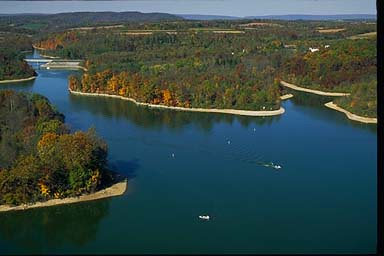
Of course, I didn't seriously consider any of this. I just paused, looked at the lake over my shoulder, wished I was enjoying this a bit more, and then trudged onward.
After another annoyingly long incline, which I mostly walked, there was a bit more trail, and then all of a sudden I was on a park road, winding my way toward the finish line. I ran hard the last couple hundred yards, you know, to look tough and strong at the end.

Official time: 6:14:29. According to my watch, my stoppage time (time spent not moving, either at aid stations or behind trees urinating) was about 15 minutes. So if I had just never stopped moving...
The post-race spread was impressive: bratwursts, potato pancakes, grilled cheese. Finishers also got a little extra swag--lawn chairs--to go with our tech shirts and hats we got before the race.
I did it! Hooray!
After enjoying the moment, though, I immediately began to wonder, "At what cost?" When would I be able to run again?
I originally started running (just a couple years ago) because I knew, for health reasons, I really should have some regular cardiovascular exercise in my life. Once I got past the gasping-for-air stage, I started to actually love doing it. I wanted to run farther and farther; I loved spending all that time outside, moving along trails, breathing in fresh air, feeling my mind and body in-the-moment, in-space, in-my-surroundings, and occasionally letting my mind drift wherever it did during a long run, meditating on this and that. When I finished a run, I would think about where and when I would run next.
Normally running is something I do in solitude, but races give me a chance to practice this passion in a slightly more social setting. (I'm not super-chatty with other runners during races, but I like that they're there, doing what I'm doing.) Signing up for progressively more challenging races prompts me to ramp up my training, and protects against skipping runs if I happen to feel a little lazy.
But races present a real danger, too. They can usurp the main goal, which is to practice running as much as I can. Training easily becomes a means to an end, but I want my daily runs to remain ends-in-themselves.
After Blues Cruise, most of my aches and soreness went away in a couple days. But that right foot remained swollen all week. I'm going to see an orthopedic specialist today, and I'm kind of expecting him to tell me I have a stress fracture. And that might mean a month or two of no running at all.
If I had it to do over again, I really would stop at mile 24. Finishing is not worth 6 weeks of no running, however disappointing not finishing would have been. Yet, in the moment, how does one make that call rationally? How does one put aside one's competitive, masochistic, gritty drive--which one is disproportionately proud of--and decide not to push it?
A new commitment to my running life: Run today, in such a way, that you may also run tomorrow.
**UPDATE: Doctor said it's not a stress fracture, and I can run again once the swelling subsides. So glad I didn't stop at mile 24!!
After I told Michael about the tightness in my hip and knee, he agreed it was probably my IT band. He asked if I had salt pills, and I told him I'd been taking one every 5 miles. My electrolyte level should have been fine. Yuriko got some ibuprofen for me, which maybe wasn't the best idea, but I knew the knee pain was likely to get worse during the next 7 miles without it. Then I sank down into a pigeon pose to stretch out the IT band.

In retrospect, of course, I can see that this is where my race should have ended. Yet, at the time, stopping was simply not up for consideration. Michael assured me that I didn't have much left (less than 7 miles), and that I could shuffle through it. That's exactly what I wanted to hear and what I intended to do. I had been training since May--I would walk the last 7 miles if I had to.
The Yoga stretch and the ibuprofen bought me some time, and I was able to run quite a bit over the next 3 miles, where I met my "team" again at the final aid station.
Less than 4 miles to go. Knee and hip bad, but stable. Some new pain in my ankle, but whatever. Ate some more potatoes and salt. My rice milk cocktail was empty, but I refilled the bottle with Gatorade, which dissolved some traces of spirulina. Yuriko and Michael told me how close I was, and I said I'd see them at the finish line. "I'll crawl if I have to. I'll gnaw off the right leg if it gives me too much trouble."
A few minutes after heading back into the woods, a micro-burst of hot pain erupted on the top of my right foot. I tried to ignore it, but as the pain and pressure increased, I stopped to check it out. It felt like my laces were too tight, but they weren't. My foot was just swelling, rapidly, and there was no longer enough room for it in my old ASICS (which had too many miles on them).
The intensity of the pain was rolling, like the hills, like a sine wave, and strangely I had these little bursts of energy where I felt like I could run up inclines easily, until the pain came back. I wasn't really tired. But I was definitely tired of the pain.
About a mile and half from the finish, there is this gorgeous overlook, and I wanted to sit there and just stare at sunlight bouncing off the lake, framed with all the oranges and yellows of early foliage. And why not? The dude who won the race had finished about two and a half hours ago. I wasn't going to meet my sub-6-hour goal. Why not just sit down, take off my shoes, give my swollen foot some space to breathe, relax, and enjoy this gorgeous view? Wasn't 29.5 miles enough?
Of course, I didn't seriously consider any of this. I just paused, looked at the lake over my shoulder, wished I was enjoying this a bit more, and then trudged onward.
After another annoyingly long incline, which I mostly walked, there was a bit more trail, and then all of a sudden I was on a park road, winding my way toward the finish line. I ran hard the last couple hundred yards, you know, to look tough and strong at the end.
Official time: 6:14:29. According to my watch, my stoppage time (time spent not moving, either at aid stations or behind trees urinating) was about 15 minutes. So if I had just never stopped moving...
The post-race spread was impressive: bratwursts, potato pancakes, grilled cheese. Finishers also got a little extra swag--lawn chairs--to go with our tech shirts and hats we got before the race.
I did it! Hooray!
After enjoying the moment, though, I immediately began to wonder, "At what cost?" When would I be able to run again?
I originally started running (just a couple years ago) because I knew, for health reasons, I really should have some regular cardiovascular exercise in my life. Once I got past the gasping-for-air stage, I started to actually love doing it. I wanted to run farther and farther; I loved spending all that time outside, moving along trails, breathing in fresh air, feeling my mind and body in-the-moment, in-space, in-my-surroundings, and occasionally letting my mind drift wherever it did during a long run, meditating on this and that. When I finished a run, I would think about where and when I would run next.
Normally running is something I do in solitude, but races give me a chance to practice this passion in a slightly more social setting. (I'm not super-chatty with other runners during races, but I like that they're there, doing what I'm doing.) Signing up for progressively more challenging races prompts me to ramp up my training, and protects against skipping runs if I happen to feel a little lazy.
But races present a real danger, too. They can usurp the main goal, which is to practice running as much as I can. Training easily becomes a means to an end, but I want my daily runs to remain ends-in-themselves.
After Blues Cruise, most of my aches and soreness went away in a couple days. But that right foot remained swollen all week. I'm going to see an orthopedic specialist today, and I'm kind of expecting him to tell me I have a stress fracture. And that might mean a month or two of no running at all.
If I had it to do over again, I really would stop at mile 24. Finishing is not worth 6 weeks of no running, however disappointing not finishing would have been. Yet, in the moment, how does one make that call rationally? How does one put aside one's competitive, masochistic, gritty drive--which one is disproportionately proud of--and decide not to push it?
A new commitment to my running life: Run today, in such a way, that you may also run tomorrow.
**UPDATE: Doctor said it's not a stress fracture, and I can run again once the swelling subsides. So glad I didn't stop at mile 24!!
Thursday, October 2, 2014
"Brofelby" (Part 2)
(continuation of a work-in-progress)
Unsure of the algorithm Brofelby would ultimately use to generate grades, students became somewhat paranoid that any little screw-up might one day be used against them. What if it's just based on attendance? What if it's all participation? What if he's taking off a point for each comma splice or spelling error?
So they came to class on time; they participated; they edited the best they could. It was the only way to manage the anxiety.
Then, oddly, after awhile, everyone seemed to just forget about it. Class became interesting because everyone talked. When essays were handed back, students couldn't find any grades, so they were forced to read the comments, looking for little hints. What they found instead were little bits of praise for their efforts, and a suggestion or two about what to try next time. This was a pleasant surprise. Maybe not quite as viscerally satisfying as knowing you had an "A", but agreeable nonetheless.
During Finals Week, when students presented their portfolios, they were genuinely proud not only of their own work, but of each other's work. Students lingered around after Brofelby's end-of-term pep talk to compliment each other and to make plans to meet up during break.
No one asked about grades. Brofelby might have thought, Success! They have been liberated!, except that he didn't. It simply wasn't on his mind. He was just enjoying the end of a particularly successful semester.
Three days before Christmas the dream was shattered. Brofelby was wandering around the King of Prussia Mall, a little lost, shopping for his wife and dog, when his cell phone rang.
Dum-dum-dum-dum-dum. (His ringtone was the opening bar from Beethoven's Fifth.)
"Hello?"
"Professor Brofelby, this is Tom from the Registrar's Office. We seem to be missing your grades from all your courses this semester. Did you try to submit them on Banner? We're trying to figure out what happened."
It was the first time anyone had mentioned grades to him since his conversation with Shakima. He was, initially, shocked and confused. What is the man talking about? Doesn't he know I don't do that sort of thing anymore? Then he realized his mistake. No -- no one knew. Only his students. And they weren't here to help him explain.
"Um...no...I'm not...um...I think I'll have to get back to you about this."
"Ok, professor, but please do so soon. If any students didn't pass, we'll need to readjust their schedules for the Spring. The sooner we know, the better."
"Of course. I just need to...check my records."
"The campus is open tomorrow, but then closed for the holiday. Do you think you could figure things out in the morning?"
"I'll do my best, Tom. Thanks for calling."
The next morning, Brofelby woke up early, walked his dog, cooked pancakes for himself and his wife (she preferred agave syrup on hers; he maple on his), put on his second best suit--complete with vest and tie--as well as his scarf, gloves, hat, and overcoat, and made his way with his own two feet to his supervisor's office.
The Dean was a good man, and Brofelby respected him. Many times in the past the two had debated matters of great importance--the modern relevance of Great Books, the conditions (if any) when it is advisable to split an infinitive--and although they didn't always reach consensus, they knew that each was committed to a dignified vision of progress.
Brofelby was a tad out of breath when he arrived at the Dean's office (which was on the fourth floor). The Dean heard him panting as he approached.
"Brofelby! Good to see you! Why the hell haven't you turned in your grades?" This was not said angrily, but more in an affectionate oh-you-incorrigible-absent-minded-professor-you way.
"That..." Brofelby paused to catch his breath, "is what I need to talk to you about."
"Let me guess. You did all your grading on an Excel spreadsheet for the first time, and then you spilled your coffee on your laptop and it wiped everything out. You're worse than the students!" Oh-you-so-and-so!
"No," Brofelby said, simply. The Dean heard the strange tone of his voice and dropped his jocular demeanor.
"What is it, Brofelby?"
"I've decided...no more grades."
The Dean beamed. Brofelby is such a character! He couldn't wait to find out what this was all about.
"What do you mean, Brofelby?"
"I won't be grading anymore."
"How is that, exactly?"
"I'm just not doing it. I haven't been doing it all semester."
Brofelby felt much better now that he had confessed.
"You mean...you didn't grade any papers? How did you get away with that? I mean, nobody likes grading, but everybody does it. It's part of the job, Brofelby. What were you thinking?"
"I read my students' essays. I gave them comments. I assessed their work qualitatively. I think that should be enough."
"But no grades."
"No grades."
"But why?"
"It's better this way."
The Dean nodded. He had to admit, it made a kind of sense. But it put him in a very awkward position. Students were bound to call. Parents were bound to call. The Provost will want an answer. There have to be grades.
"So," the Dean said. "Should we just give them all 'A's?"
Brofelby shook his head. "No grades."
"You're serious about this, aren't you?"
Brofelby nodded.
"This is going to be a hard sell, you know. I can't see it going over well."
Brofelby nodded.
"Hmm...no grades. That's something."
For an instant, Brofelby felt a kind of electric surge--he wanted to give one grade. Shakima. She deserved an "A." There's always one. One who stands out. One you know is going places. You want to give her that "A" because she's given you so much.
But then it hit him. She doesn't need it. She doesn't need my "A." She'll be fine.
Thursday, September 25, 2014
"Brofelby"
Here is a work-in-progress for any ENG 205 students who may stumble upon it.
Professor Brofelby loved most things
about his job; however, like many writing teachers, he always dreaded
grading papers. It wasn't that he didn't like reading his students'
essays—not at all. He loved those little glimpses into how their
evolving minds worked. A nostalgic intimacy warmed him as he pored
over their earnest endeavors to wrestle with the same Big Questions
so many generations have grappled with before.
No, it wasn't the reading that
bothered him—it was the grading.
Shakima undoubtedly spent hours
on this assignment. She re-wrote the introduction entirely after I
told her to get rid of all those generalizations. Her revised thesis
statement—that political cynicism is a self-fulfilling prophecy—is
so much sharper than its predecessor (voting is pointless). Sure, she
is still dropping in quotes out of context and switching points
without transitions, but she has made real progress. She is growing.
How can I take all her blood, sweat, and tears and reduce it to a
“B-”?
It
was time to put his foot down. No more grading.
He
was reminded of 2003, when he protested the Iraq War. He knew he
would be misunderstood, but he also knew he had to follow his
conscience. Maybe this wasn't a matter of life and death, like the
war had been, but grading (he was convinced) was its own kind of
violence.
An
essay is not a game of bowling to be scored in so many boxes. Nice
argument! Strike! Your next two paragraphs are now worth double
points! It's a window into a multi-dimensional
consciousness, into a thinker/speaker/feeler, into a human soul,
goddamit!
No,
he wouldn't do it. He would still read them, of course. He would
still write his little paragraphs of feedback (mostly encouraging,
with a little constructive criticisms here and there—nothing too
overwhelming). But that was all. No points. No percentages. No big
red letters with circles around them. No checks or check pluses or
check minuses.
After
he handed back the first batch of essays, he braced himself for the
backlash. But it didn't come. Not right away.
Maybe
they won't notice. Maybe they'll just read my comments and reflect on
them and think about how to make adjustments for next time. Maybe
this will solve everything.
He knew that was
mostly fantasy.
More likely
they think I'm getting senile and just forgot the bloody
grades. Or maybe they're afraid to ask.
Professor
Brofelby was only five foot two, and didn't really understand how
anyone could be intimidated by him, but he knew from experience that
students often were.
They're
confused. They're afraid to ask. That must be it. Should I say
something? Make a little speech? Do I owe them an explanation?
He
decided no, he preferred not to explain. He would just pretend, as
long as he could, that nothing had changed, that this was the way it
had always been done.
After the second
round of papers were returned, there was still no reaction in class.
No hands went up, though Professor Brofelby was sure that
everyone was thinking the same thing: What about our f&*%ing
grades, dude?
Not
surprisingly, Shakima was the brave one who finally broke the
silence. She was that one student—Brofelby seemed to be blessed
with one every semester—the one who stopped by during office hours
to show him her rough draft; the one who would email him, with
excessive formality (Dear Professor Brofelby, Ph.D.:) asking for
clarification about some citation minutiae (Yours sincerely, Shakima
Jackson, from your MW ENG 101 class that meets at 9:40am). She was
driven, and not just for a perfect GPA; she really believed that
education was going to change her life. Still, she needed to know.
“Professor?”
“Shakima,
hello! Come in; have a seat. Would you like a chocolate biscuit?”
(Brofelby was
not British, but he always seemed to have a tin of McVitties on his
desk—and always eager to share.)
“Oh...no thank
you, sir.”
“What's on
your mind, Shakima?”
“I was
wondering if I could talk to you about my last essay.”
“Of course.
Did you get a chance to look over my comments? I hope my handwriting
was legible.”
“Yes, sir, I
did. I think I understood them. I was just wondering...I mean...you
were very specific about what you liked and about what you thought
was...you know...not-so-great. But I guess I was wondering what you
thought of it overall?”
“Overall, I
thought it showed a lot of promise. Your critical thinking skills are
really starting to shine through.”
“So...is that
like...a 'B'...ish?”
Brofelby
frowned. Then he sighed. He knew he couldn't answer her question, but
he knew he had to say something. He liked her; he sympathized; he
pitied her. The world had so conditioned her to the violence of
grading that here she was longing to be disciplined—longing to know
the dimensions and decorations of her pigeonhole.
No, Shakima—I
will not place you in a box.
“It's a good
essay, Shakima. It has its flaws—it's not the best you will ever
write—but it's good.”
There, that
was honest.
“But...aren't
you going to give it a grade?”
“I would
really prefer not to.”
“But...why?
What does that mean?”
He thought, for
a minute, about trying to explain it to her. He felt confident she
would understand. But he was a little afraid that she might repeat
what he said to others, and that she might not represent his
“grading=violence” epiphany with complete accuracy. Paraphrasing,
he knew, was not her strongest skill.
“I'm doing
things a little differently this semester, that's all. Don't worry
about your grade. Just worry about your writing. Better still, don't
worry at all. Just keep doing what you're doing. It will be fine.
Trust me.”
Shakima gave him
a look—a new look—a look he had not seen from her before. Her
lips tightened and her eyes narrowed. Brofelby guessed that he wasn't
the first person to ask for Shakima's trust in such a dodgy manner.
He had set off some red flags.
“So does this
essay...does it even count?”
“Of course it
counts. Everything counts.”
“I mean does
it count for our grade.”
Brofelby had not
yet decided what he was going to do about final course grades. He
knew, even with tenure, it would be difficult to avoid submitting
them. He didn't like the idea of giving everyone “A”s (or any
other grade). He had read some articles about “holistic” grading,
but reducing an entire semester's worth of struggle and growth into a
single quantity seemed even more violent than doing that to an essay.
In short, he didn't yet have a plan, but he was not prepared to
confess this to Shakima.
“Is that all
you care about, Shakima? Your grade?”
This was not a
fair thing to say, and he regretted saying it, even as it huffed out
of him.
Shakima appeared
stunned. Brofelby had only ever been kind, generous, and somewhat
awkward around here—never defensive or insinuating. Maybe he's
just having a bad day, she told herself. It probably has
nothing to do with me.
“I'm sorry,
sir. No, that's not what I meant to suggest. I just want to do well
in your class.”
“I know,
Shakima. I'm sorry, too. I know you're hear for the right reasons.
Just keep working on your writing and try not to worry about grades.”
“You'll let me
know, though, right? If I do need to worry? Later on?”
“That's a fair
request. If I think you're getting off track, I'll let you know.”
“Ok,
professor. Thanks for your time.”
“No problem,
Shakima. Take care. And take a biscuit before you go.”
“Ok,” she
said, with an uncertain smile, reaching into the tin. “Thanks.”
“Any time.”
Thursday, September 18, 2014
When You Can't Remember the Last Time You Wrote a Poem, It Might Be Time to Write a Poem
If I had to guess, I would say sometime around 2006. And I think it was a sonnet. For an ex-girlfriend. It's probably for the best that I can't remember more than that. Let's make some new memories (by way of new verses).

My wife drives one of those little Smart Cars,
and she drives it hard.
If you're between her and Point B,
you are that-which-must-be-circumvented.
If you're behind her,
you're where you should be.
One day when I went to adjust my rearview mirror,
it snapped right off.
Suddenly, I was just holding it, like a banana or a remote control.
I dropped it on the passenger's seat--who needs it?
Everything it shows me is in the past;
better to keep my eyes on the future.
When Kima was a puppy, she used to vomit every time we took her in the car.
So we stopped feeding her before trips.
She would lie down on the backseat and drool all the way to Maryland.
And sometimes vomit anyway--greenish yuck.
Then, one day, she learned to sit up and look out the window.
Now, as she rides, she can take things in rather than let things out.
We took the Smart Car to Jim Thorpe one Valentine's Day weekend.
Thick patches of ice covered the streets and parking lots.
The first time we got stuck,
I wondered if we could simply pick the car up and move it off the ice.
Not quite. It's still a car. A little car, but a car. And we're little people.
People, but little people.
When I was 23, I bought a used Pontiac from a friend.
Never do this. Never buy a car from a friend. And never buy a used Pontiac.
After it wouldn't pass inspection,
she grudgingly agreed to take the car back and return my money.
We haven't spoken since.
Should've just taken the bus.
After I got my license and started driving by myself and with my friends,
I seemed to have a near-death experience at least once a week.
Perhaps, like many, I have a hyperbolic memory,
But I recall countless blown stop signs,
A myriad of reckless lane changes,
And a persistently foolish belief that acceleration could solve all problems.
During the winter we lived in Reading,
and Yuriko was commuting to and from Ursinus College,
in the Smart Car...in the snow....in traffic...
on 422, all frozen and black-iced,
I thought my share of paranoid thoughts,
which always ended in the unanswerable, "How will I go on?"
For three years in my 20s, I had no car at all.
One of those years was in Boston:
I bought a bus/subway combo pass.
I could go anywhere, as long as I wasn't in a hurry.
The other two years were in Binghamton.
Buses were free with my student ID, but it took forever to get to Wegmans.
In high school, I drove a Buick handed down to me from my sister.
For several months Paul Simon's "Graceland" was trapped in the tape deck.
The player had an auto-reverse feature,
so when one side ended, the other automatically began.
Over and over I went to Graceland, Graceland, Memphis, Tennessee,
with Paul Simon as my bodyguard.
I don't know if this actually happened: I was driving from Auburn to Albany,
on the New York State Thruway, in the middle of the night, not yet 20 years old.
I was exhausted and should not have been on the road.
Suddenly a car pulled out of the median, perpendicular to my progress.
I swerved onto the shoulder, narrowly evading it, nearly losing control;
then swerved back, Epicuriously, adrenaline pumping, awake and alive.
I've never had sex in a car.
(At least I can't remember ever having sex in a car.)
I've made out in cars, gotten to second base in cars, but that's it.
Did I miss out on some iconic, American teenage experience?
Should I make up for lost time,
even though so many more spacious locales are now readily available?
I was somewhere near Kutztown, headed to the Catskills for my bachelor party,
when Yuriko called me to say, through sobs, that Baylor, our dog, had collapsed.
I turned around and drove home, but of course there was nothing I could do.
Michael, our neighbor, helped me move his 90-pound body to my Nissan.
When I think of that handsome, joyful dog, I still feel that weight--
that weight that was no longer him.
I don't actually like cars.
In fact, I think the invention of the car was a disaster.
Think of how it accelerated the consumption of fossil fuels.
Think of how it catalyzed (sub)urban sprawl.
Think of the lives and living wasted by drunk drivers and traffic jams.
I dream of a world with more trains. And bicycles. And walking.
In 2002, a man named Bob and I pooled our money to buy a Geo Metro for $800.
We were in Sitka, Alaska.
Three months later, we decided to put it on a ferry to get back to the mainland,
and then drive it across the continent to upstate New York.
We saw aurora borealis in the Yukon, caribou along the Great Alaska Highway,
Superior waves in Thunder Bay; we lingered a few days in Sault Ste. Marie.
I know a woman who, years ago, drunkenly crashed her car into a house.
She confessed this to me one night as we dined at an Italian restaurant.
She had fled the scene. The police had never connected her to it.
Maybe I didn't know this woman.
Maybe she was a fiction whom a stranger and I both collaborated in creating.
Or maybe the parts of some people--or all people--just don't add up.
I'm nostalgic for the days before GPS, when I used to get lost all the time.
I believed getting lost and then unlost was the best way to learn my way around.
Maybe I still believe that.
At least back then, when I was lost, I knew I was lost.
Now I seem to disappear in my head every few miles, and then I'm on the road,
but I don't know which road, and I don't know if I know where I am.
"Auto-Pilot"
My wife drives one of those little Smart Cars,
and she drives it hard.
If you're between her and Point B,
you are that-which-must-be-circumvented.
If you're behind her,
you're where you should be.
One day when I went to adjust my rearview mirror,
it snapped right off.
Suddenly, I was just holding it, like a banana or a remote control.
I dropped it on the passenger's seat--who needs it?
Everything it shows me is in the past;
better to keep my eyes on the future.
When Kima was a puppy, she used to vomit every time we took her in the car.
So we stopped feeding her before trips.
She would lie down on the backseat and drool all the way to Maryland.
And sometimes vomit anyway--greenish yuck.
Then, one day, she learned to sit up and look out the window.
Now, as she rides, she can take things in rather than let things out.
We took the Smart Car to Jim Thorpe one Valentine's Day weekend.
Thick patches of ice covered the streets and parking lots.
The first time we got stuck,
I wondered if we could simply pick the car up and move it off the ice.
Not quite. It's still a car. A little car, but a car. And we're little people.
People, but little people.
When I was 23, I bought a used Pontiac from a friend.
Never do this. Never buy a car from a friend. And never buy a used Pontiac.
After it wouldn't pass inspection,
she grudgingly agreed to take the car back and return my money.
We haven't spoken since.
Should've just taken the bus.
After I got my license and started driving by myself and with my friends,
I seemed to have a near-death experience at least once a week.
Perhaps, like many, I have a hyperbolic memory,
But I recall countless blown stop signs,
A myriad of reckless lane changes,
And a persistently foolish belief that acceleration could solve all problems.
During the winter we lived in Reading,
and Yuriko was commuting to and from Ursinus College,
in the Smart Car...in the snow....in traffic...
on 422, all frozen and black-iced,
I thought my share of paranoid thoughts,
which always ended in the unanswerable, "How will I go on?"
For three years in my 20s, I had no car at all.
One of those years was in Boston:
I bought a bus/subway combo pass.
I could go anywhere, as long as I wasn't in a hurry.
The other two years were in Binghamton.
Buses were free with my student ID, but it took forever to get to Wegmans.
In high school, I drove a Buick handed down to me from my sister.
For several months Paul Simon's "Graceland" was trapped in the tape deck.
The player had an auto-reverse feature,
so when one side ended, the other automatically began.
Over and over I went to Graceland, Graceland, Memphis, Tennessee,
with Paul Simon as my bodyguard.
I don't know if this actually happened: I was driving from Auburn to Albany,
on the New York State Thruway, in the middle of the night, not yet 20 years old.
I was exhausted and should not have been on the road.
Suddenly a car pulled out of the median, perpendicular to my progress.
I swerved onto the shoulder, narrowly evading it, nearly losing control;
then swerved back, Epicuriously, adrenaline pumping, awake and alive.
I've never had sex in a car.
(At least I can't remember ever having sex in a car.)
I've made out in cars, gotten to second base in cars, but that's it.
Did I miss out on some iconic, American teenage experience?
Should I make up for lost time,
even though so many more spacious locales are now readily available?
I was somewhere near Kutztown, headed to the Catskills for my bachelor party,
when Yuriko called me to say, through sobs, that Baylor, our dog, had collapsed.
I turned around and drove home, but of course there was nothing I could do.
Michael, our neighbor, helped me move his 90-pound body to my Nissan.
When I think of that handsome, joyful dog, I still feel that weight--
that weight that was no longer him.
I don't actually like cars.
In fact, I think the invention of the car was a disaster.
Think of how it accelerated the consumption of fossil fuels.
Think of how it catalyzed (sub)urban sprawl.
Think of the lives and living wasted by drunk drivers and traffic jams.
I dream of a world with more trains. And bicycles. And walking.
In 2002, a man named Bob and I pooled our money to buy a Geo Metro for $800.
We were in Sitka, Alaska.
Three months later, we decided to put it on a ferry to get back to the mainland,
and then drive it across the continent to upstate New York.
We saw aurora borealis in the Yukon, caribou along the Great Alaska Highway,
Superior waves in Thunder Bay; we lingered a few days in Sault Ste. Marie.
I know a woman who, years ago, drunkenly crashed her car into a house.
She confessed this to me one night as we dined at an Italian restaurant.
She had fled the scene. The police had never connected her to it.
Maybe I didn't know this woman.
Maybe she was a fiction whom a stranger and I both collaborated in creating.
Or maybe the parts of some people--or all people--just don't add up.
I'm nostalgic for the days before GPS, when I used to get lost all the time.
I believed getting lost and then unlost was the best way to learn my way around.
Maybe I still believe that.
At least back then, when I was lost, I knew I was lost.
Now I seem to disappear in my head every few miles, and then I'm on the road,
but I don't know which road, and I don't know if I know where I am.
Thursday, September 11, 2014
A Year to Write
When I was in high school, I published a "zine" called Iconoclast which featured an eclectic assortment of obscene, bizarre, and mostly terrible poetry by myself and my friends. I also attended a variety of open-mic poetry events in Albany, New York, performing my own work and listening to the inspired ravings of fellow upstate oddities. I remember this terribly pretentious poet named R. M. Englehardt, whom I always used to make fun of with my friends. I remember having a Mrs. Robinson-style crush on another poet, Mary Panza, who was twice my age. I also remember, quite affectionately, these three old dudes who called themselves "3 Guys from Albany" and read their work as part of a collaborative performance. Albany poetry: it was a scene, sort of.
When I left home for college, I knew I wanted to write. I even picked a college (Bard) that sounded like it was built for writers. I knew that it was unlikely I would ever make a living as a writer, but I didn't think I needed to worry about that yet. College, for me, wasn't about being practical. It was dreamlike. It was a world of ideas and imagination. It was filled with the joy of knowing that high school was over, and the repressed anxiety that one day the dream would end, and I'd be a starving artist of some kind.
My number one priority freshman year was to get into a Poetry Workshop. At Bard, you couldn't just sign up to take Creative Writing--you had to submit a portfolio of your work in order to demonstrate that you were serious about your craft. The professor would look over the portfolios and decide which students he/she wanted to work with. There were always more portfolios than spots in the class. Not everybody made the poetry team.
I scrutinized my work. I sweated. I revised. I put together a collection of my best poems.
I didn't make the cut. I didn't even make the waiting list.
In hindsight, this wasn't all that surprising. I had never read much poetry, especially not contemporary poetry. Aside from Allen Ginsberg, the only living poets I was really familiar with were the local versifiers from Albany. That kind of poetry didn't really cut it at Bard.
Later that semester, I got a voicemail from Peter Sourian, who taught a creative writing workshop in prose fiction. Professor Sourian had been on an Amtrak train, chatting with a conductor, who had mentioned that he knew a young man--a friend of his daughter's--who was studying at Bard. "He's a nice young man. Check up on him, if you think of it." And he did.
I took Professor Sourian's invitation to stop by during his office hours and introduce myself. We chatted about our common acquaintance--my friend Michelle's dad--and about a writer from Albany whom we both admired (William Kennedy). When it came time to register for Spring classes, I submitted a portfolio of short stories for Professor Sourian's fiction workshop. Of course, I got a spot in the class.
Would I have ended up in that class if my friend's dad hadn't talked me up to this professor on a train? I'll never know. I decided to believe that I was simply a much better fiction writer than I was a poet.
Professor Sourian ran his workshop in pretty old-school fashion. At the end of a class, he'd tell a few of us to bring a story to the next class. At the next class, he'd read a story aloud and ask everyone to say what they thought of it. You'd sit there and listen to your classmates and your professor analyze your work, sometimes generously and sometimes harshly. It was not for the faint of heart.
The first story I submitted for the class was pretty terrible. Professor Sourian said something to the effect of, "There's no story in your story."
The next story I wrote was about a friend of mine who had been molested, as a child, by her uncle. The third story I wrote for the class was about coming to terms with my father's death. These stories were both probably emotionally overwrought and painfully amateurish, but they were better. They had their moments.
I ended up taking two more fiction workshops while at Bard, one with Richard Ford (who was pretty well-known) and one with Liz Strout (who would go on to become very well-known). Writing fiction didn't exactly come easy to me, but I was definitely getting better. When I wrote, I often tried to create somewhat mythic versions of real people I knew in my life, and to place them in mythic versions of real places I had been. Sometimes I felt like I was writing portraits; sometimes I felt like I was writing landscapes. Sometimes I was going for realism; sometimes for fantasy.
One of the graduation requirements at Bard is a year-long, 8-credit project, completed during one's senior year. I decided to write a collection of short stories for my project, and Professor Sourian was one of three professors who read and evaluated my work. The collection was called Where Things Come Together: Stories of the Northern Hudson. Each story was set in a different town along the Hudson River and featured a character loosely based on someone from my past whose real story had fascinated me at some point. (Maybe I should have just written little biographies of ordinary people. I often wonder if I could make that into a marketable genre.)
My senior year at Bard was the high point of my writing life--far more pleasurable than the years I spent writing my dissertation for my PhD. (Of course, writing a collection of short stories and writing a dissertation are very different projects. Both require imagination and insight, but one is geared toward a broad audience, while the other is for quite a narrow one.) I lived in an old dormitory that year, called "Manor", with a clunky old radiator that I couldn't control. I remember (wastefully) keeping my window open in the dead of winter to avoid broiling. I remember sitting at my little desk, with a faint view of the Catskills, typing away while pockets of cold and hot air swirled and mixed around me. I remember creating scenes and characters that excited me, and I remember the moments of terror when I thought it was all crap--that I had spent months producing total garbage. I remember sharing stories with friends and professors, afraid to hear the truth. I remember the relief when they told me, "I think maybe you've got something here."
Of all the great things Bard gave me, perhaps that was the greatest. A year to write.
When I left home for college, I knew I wanted to write. I even picked a college (Bard) that sounded like it was built for writers. I knew that it was unlikely I would ever make a living as a writer, but I didn't think I needed to worry about that yet. College, for me, wasn't about being practical. It was dreamlike. It was a world of ideas and imagination. It was filled with the joy of knowing that high school was over, and the repressed anxiety that one day the dream would end, and I'd be a starving artist of some kind.
My number one priority freshman year was to get into a Poetry Workshop. At Bard, you couldn't just sign up to take Creative Writing--you had to submit a portfolio of your work in order to demonstrate that you were serious about your craft. The professor would look over the portfolios and decide which students he/she wanted to work with. There were always more portfolios than spots in the class. Not everybody made the poetry team.
I scrutinized my work. I sweated. I revised. I put together a collection of my best poems.
I didn't make the cut. I didn't even make the waiting list.
In hindsight, this wasn't all that surprising. I had never read much poetry, especially not contemporary poetry. Aside from Allen Ginsberg, the only living poets I was really familiar with were the local versifiers from Albany. That kind of poetry didn't really cut it at Bard.
Later that semester, I got a voicemail from Peter Sourian, who taught a creative writing workshop in prose fiction. Professor Sourian had been on an Amtrak train, chatting with a conductor, who had mentioned that he knew a young man--a friend of his daughter's--who was studying at Bard. "He's a nice young man. Check up on him, if you think of it." And he did.
I took Professor Sourian's invitation to stop by during his office hours and introduce myself. We chatted about our common acquaintance--my friend Michelle's dad--and about a writer from Albany whom we both admired (William Kennedy). When it came time to register for Spring classes, I submitted a portfolio of short stories for Professor Sourian's fiction workshop. Of course, I got a spot in the class.
Would I have ended up in that class if my friend's dad hadn't talked me up to this professor on a train? I'll never know. I decided to believe that I was simply a much better fiction writer than I was a poet.
Professor Sourian ran his workshop in pretty old-school fashion. At the end of a class, he'd tell a few of us to bring a story to the next class. At the next class, he'd read a story aloud and ask everyone to say what they thought of it. You'd sit there and listen to your classmates and your professor analyze your work, sometimes generously and sometimes harshly. It was not for the faint of heart.
The first story I submitted for the class was pretty terrible. Professor Sourian said something to the effect of, "There's no story in your story."
The next story I wrote was about a friend of mine who had been molested, as a child, by her uncle. The third story I wrote for the class was about coming to terms with my father's death. These stories were both probably emotionally overwrought and painfully amateurish, but they were better. They had their moments.
I ended up taking two more fiction workshops while at Bard, one with Richard Ford (who was pretty well-known) and one with Liz Strout (who would go on to become very well-known). Writing fiction didn't exactly come easy to me, but I was definitely getting better. When I wrote, I often tried to create somewhat mythic versions of real people I knew in my life, and to place them in mythic versions of real places I had been. Sometimes I felt like I was writing portraits; sometimes I felt like I was writing landscapes. Sometimes I was going for realism; sometimes for fantasy.
One of the graduation requirements at Bard is a year-long, 8-credit project, completed during one's senior year. I decided to write a collection of short stories for my project, and Professor Sourian was one of three professors who read and evaluated my work. The collection was called Where Things Come Together: Stories of the Northern Hudson. Each story was set in a different town along the Hudson River and featured a character loosely based on someone from my past whose real story had fascinated me at some point. (Maybe I should have just written little biographies of ordinary people. I often wonder if I could make that into a marketable genre.)
My senior year at Bard was the high point of my writing life--far more pleasurable than the years I spent writing my dissertation for my PhD. (Of course, writing a collection of short stories and writing a dissertation are very different projects. Both require imagination and insight, but one is geared toward a broad audience, while the other is for quite a narrow one.) I lived in an old dormitory that year, called "Manor", with a clunky old radiator that I couldn't control. I remember (wastefully) keeping my window open in the dead of winter to avoid broiling. I remember sitting at my little desk, with a faint view of the Catskills, typing away while pockets of cold and hot air swirled and mixed around me. I remember creating scenes and characters that excited me, and I remember the moments of terror when I thought it was all crap--that I had spent months producing total garbage. I remember sharing stories with friends and professors, afraid to hear the truth. I remember the relief when they told me, "I think maybe you've got something here."
Of all the great things Bard gave me, perhaps that was the greatest. A year to write.
Wednesday, August 20, 2014
Orientation Speech, August 2014
My wife, who, like me, graduated from college more than a decade ago, recently had a dream in which she was being forced to take a math quiz. She described it as a nightmare--utter terror. Who here is afraid of math quizzes? Who's afraid of writing research papers? Who's afraid of college in general?
The good news is you're not alone. Many new college students--maybe even most--are afraid that their writing skills or their math skills or their overall academic skills won't be good enough for them to achieve their goals. This fear is common, and it's understandable, but it's not very helpful. The most important bit of advice I can give you is not to let this fear hold you back.
If you're not a very good writer, it's not a big deal. (Yes, I'm an English professor, and I just said that.) Nearly all college students struggle with writing during their first few semesters. What matters more is how good your writing is a year from now, two years from now, four years from now. The same is true for math, or any other academic skill. It doesn't matter where you start; it matters where you finish, and what you learn along the way.
In order for that learning to take place, you need to believe that you are capable of improvement. If you think you are a bad writer, and that's just who you are--or that you're bad at math and nothing can change that--then you are making your own education impossible. Change can only happen if you believe it can happen. People who believe they can't get better at something don't bother practicing. But those who are driven to better themselves keep trying, no matter how many setbacks and obstacles they encounter, and that persistence eventually produces results.
When students in my classes don't succeed, it's not because they're bad writers. It's because they stop coming to class or because they don't hand in their work. If these students had simply come to class and tried their best on their assignments, they would have passed. Maybe they would've gotten "C's" and not "A's", but so what. There's more to life than grades. You are more than your GPA.
There are many different reasons why this happens, but I believe fear to be the most common one. By avoiding class and avoiding assignments, these students are trying to avoid judgment. They are afraid that their professors will confirm their worst fear--that they don't belong here, that they don't have what it takes to get a college degree.
But having what it takes isn't about being super-smart. It's about persevering through all the stress and anxiety. It's about not letting one or two bad grades discourage you. It's about moving forward, no matter what. And your professors aren't here merely to judge you. It's not my job to survey all my students and decree, "You are the smart ones," and "You are the not-smart ones." My job is to help all my students meet their goals. The job of everyone who works at this college is to help you succeed. We all want that. So when you feel that fear, or if you just feel stuck--not sure how to get through a particular class or a particular assignment--talk to a professor, talk to a counselor, talk to a tutor. And talk to each other--you all will be experiencing the same challenges.
Let me end by giving you some specific, practical advice, and then a little homework.
#1. Don't skip class. Ever. If you're deathly ill or there is a true emergency, then fine, but otherwise go to every class no matter what. Showing up is more than half the battle. It's at least two thirds.
#2. When you're in class, find ways to be active. Lots of people will tell you about how important it is to take notes, and yes, note-taking is helpful. But don't do it passively. Make sure you understand what you're writing down. When you don't understand something, ASK A QUESTION. When your professors invite you to share your thoughts and opinions, share them. If you're not interacting with your classmates and your professor in class, you're not learning as much as you could be.
#3. Organize your time. Use a planner; use an app; use whatever works for you. Keep track of when things are due and when you will have the time to do them. If you're a full-time student, expect 15-20 hours of homework every week. Finding time to get it all done can be a real challenge if you also have a full- or part-time job. Carefully organizing your time is the only way.
#4. Talk to your professor outside of class. Any time you are confused or just want some feedback on your work, talk to your professor one-on-one. Don't be intimidated. We're all quite friendly once you get to know us. Many of us have regular office hours, which will be posted on the course syllabus. "Office Hours" means you can drop in WITHOUT an appointment. It doesn't mean we're in our offices doing important office work and cannot be disturbed. By all means, disturb us. We're here to help. It's our job.
#5. Turn in your work on time. Late work drives professors nuts, and many of us simply won't accept it. If you know you can't make a deadline, talk to your professor well in advance, and ask for an extension. There's no shame in asking--worst case scenario, the professor says no. But most of us are pretty accommodating with such requests, as long as you don't wait until the last minute.
Ok, now for your homework assignment. Little warning--it involves some math. When you get home, divide your total tuition bill by the number of times your classes are scheduled to meet throughout the entire semester. This will show you how much you are paying per class. Figure out what this number is. Keep it in mind the next time you're not sure if you have the energy to go to class. Let it motivate you. You already bought the ticket. It's time to take the ride.
Good luck.
The good news is you're not alone. Many new college students--maybe even most--are afraid that their writing skills or their math skills or their overall academic skills won't be good enough for them to achieve their goals. This fear is common, and it's understandable, but it's not very helpful. The most important bit of advice I can give you is not to let this fear hold you back.
If you're not a very good writer, it's not a big deal. (Yes, I'm an English professor, and I just said that.) Nearly all college students struggle with writing during their first few semesters. What matters more is how good your writing is a year from now, two years from now, four years from now. The same is true for math, or any other academic skill. It doesn't matter where you start; it matters where you finish, and what you learn along the way.
In order for that learning to take place, you need to believe that you are capable of improvement. If you think you are a bad writer, and that's just who you are--or that you're bad at math and nothing can change that--then you are making your own education impossible. Change can only happen if you believe it can happen. People who believe they can't get better at something don't bother practicing. But those who are driven to better themselves keep trying, no matter how many setbacks and obstacles they encounter, and that persistence eventually produces results.
When students in my classes don't succeed, it's not because they're bad writers. It's because they stop coming to class or because they don't hand in their work. If these students had simply come to class and tried their best on their assignments, they would have passed. Maybe they would've gotten "C's" and not "A's", but so what. There's more to life than grades. You are more than your GPA.
There are many different reasons why this happens, but I believe fear to be the most common one. By avoiding class and avoiding assignments, these students are trying to avoid judgment. They are afraid that their professors will confirm their worst fear--that they don't belong here, that they don't have what it takes to get a college degree.
But having what it takes isn't about being super-smart. It's about persevering through all the stress and anxiety. It's about not letting one or two bad grades discourage you. It's about moving forward, no matter what. And your professors aren't here merely to judge you. It's not my job to survey all my students and decree, "You are the smart ones," and "You are the not-smart ones." My job is to help all my students meet their goals. The job of everyone who works at this college is to help you succeed. We all want that. So when you feel that fear, or if you just feel stuck--not sure how to get through a particular class or a particular assignment--talk to a professor, talk to a counselor, talk to a tutor. And talk to each other--you all will be experiencing the same challenges.
Let me end by giving you some specific, practical advice, and then a little homework.
#1. Don't skip class. Ever. If you're deathly ill or there is a true emergency, then fine, but otherwise go to every class no matter what. Showing up is more than half the battle. It's at least two thirds.
#2. When you're in class, find ways to be active. Lots of people will tell you about how important it is to take notes, and yes, note-taking is helpful. But don't do it passively. Make sure you understand what you're writing down. When you don't understand something, ASK A QUESTION. When your professors invite you to share your thoughts and opinions, share them. If you're not interacting with your classmates and your professor in class, you're not learning as much as you could be.
#3. Organize your time. Use a planner; use an app; use whatever works for you. Keep track of when things are due and when you will have the time to do them. If you're a full-time student, expect 15-20 hours of homework every week. Finding time to get it all done can be a real challenge if you also have a full- or part-time job. Carefully organizing your time is the only way.
#4. Talk to your professor outside of class. Any time you are confused or just want some feedback on your work, talk to your professor one-on-one. Don't be intimidated. We're all quite friendly once you get to know us. Many of us have regular office hours, which will be posted on the course syllabus. "Office Hours" means you can drop in WITHOUT an appointment. It doesn't mean we're in our offices doing important office work and cannot be disturbed. By all means, disturb us. We're here to help. It's our job.
#5. Turn in your work on time. Late work drives professors nuts, and many of us simply won't accept it. If you know you can't make a deadline, talk to your professor well in advance, and ask for an extension. There's no shame in asking--worst case scenario, the professor says no. But most of us are pretty accommodating with such requests, as long as you don't wait until the last minute.
Ok, now for your homework assignment. Little warning--it involves some math. When you get home, divide your total tuition bill by the number of times your classes are scheduled to meet throughout the entire semester. This will show you how much you are paying per class. Figure out what this number is. Keep it in mind the next time you're not sure if you have the energy to go to class. Let it motivate you. You already bought the ticket. It's time to take the ride.
Good luck.
Subscribe to:
Posts (Atom)